
From a Scrub Clearing Era to a Scrub Earning Era: How Native Regeneration Can Generate Carbon Income on Hill Country Farms
Most hill country farmers know the story.
There’s always a face or gully that’s harder to keep on top of than the rest. The scrub creeps back in, grazing pressure drops off, and before long you’re looking at another round of spraying, cutting, or mulching. The cost goes up, but the result is often the same.
For years, the answer has been to clear it. Today, there’s another option worth considering.
What Is Carbon Income from Native Bush?
New Zealand’s Emissions Trading Scheme (ETS) allows eligible landowners to earn carbon credits (known as NZUs, or New Zealand Units) from areas of regenerating native vegetation growing on their property. These credits can then be sold, turning marginal land into an alternative farm income stream.
At a rough, back-of-the-envelope level, a 100-hectare block of regenerating native scrub that has been coming away since 2005 could be earning in the vicinity of $60,000 a year through the ETS at today’s carbon price of around $51/NZU. That’s income from a piece of land that may have spent years costing money to maintain.
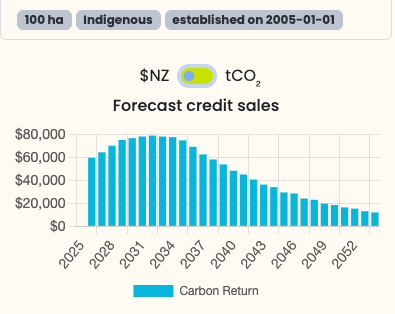
100 Hectares = $60,000/year
Graph: Bar graph showing estimated annual carbon income from a 100-hectare block of regenerating native scrub under the New Zealand Emissions Trading Scheme.
How Long Can You Earn Carbon Credits For?
It’s not just one year of income. Eligible post-1989 native forest can continue generating carbon credits for decades as it grows. For many sheep and beef farms, these areas are often the steep faces, gullies, and marginal land that have been repeatedly cleared in the past but naturally want to revert back to native bush.
Many of these regenerating blocks are already providing value. They offer shelter, help reduce erosion risk, and occupy land that was never going to be the farm’s highest-performing country. Carbon income from native bush simply adds another revenue stream on top of that.
Does Registering Native Forest in the NZ ETS Affect Farm Operations?
Registering native forest in the NZ ETS does not mean abandoning the land. Tracks can still be maintained, access retained, and farm operations can continue around these areas. The difference is that instead of budgeting for the next round of scrub control, that same block may be generating an alternative farm income.
Turning a Cost into an Income Stream on Hill Country Farms
Farming has always been about adapting to changing opportunities. For some parts of the farm, the opportunity may no longer be in clearing the scrub. It may be in recognising the value of native regeneration and turning a scrub clearing cost into a scrub earning income stream.
If you’d like to understand what carbon income opportunities may already exist on your property, get in touch with the Carbonfields team for an initial assessment.
Frequently Asked Questions
Can I earn carbon credits from regenerating scrub on my farm?
Yes. If you have areas of regenerating native scrub or bush that have been growing since 1990 or later, they may be eligible to generate NZUs (New Zealand Units) through the NZ Emissions Trading Scheme. Eligibility depends on when the vegetation started establishing and whether the land meets certain criteria. An initial assessment can confirm what applies to your property.
How much carbon income could I earn from native bush on my hill country farm?
Income varies depending on the size of the eligible area, the age and growth rate of the vegetation, and the current carbon price. As a rough guide, a 100-hectare block of regenerating native scrub established since 2005 could earn in the vicinity of $60,000 per year at today’s carbon price of around $51/NZU. A Carbonfields assessment can provide a property-specific estimate.
Will registering native bush in the ETS stop me from farming that land?
No. Registering native forest in the NZ ETS does not prevent you from continuing to farm around it. You can retain access, maintain tracks, and continue operating as normal. The main requirement is that the registered area is not cleared or significantly disturbed while it is earning credits.